Logo Drivet Transport International
Menu

Specialist equipment

Machinery transport

Transport of machinery, professional equipment or technical assets requiring a solution suited to loading.

Machinery transport

Machinery transport

Understanding machinery transport

Machinery transport consists of moving construction equipment, professional machinery and agricultural, industrial or technical equipment that requires a suitable transport solution. Unlike ordinary freight, machinery often involves specific constraints relating to its weight, dimensions, overall size, running condition, securing points and loading or unloading requirements.

This type of transport is mainly intended for companies, tradespeople, hire businesses, local authorities and professionals in construction, public works, landscaping, industry or maintenance. It may involve moving a machine between a depot and a worksite, delivering equipment to a customer, transferring machinery between two sites, returning equipment after an operation or arranging a one-off transport for an operational requirement.

Assessing the request is essential. To propose a realistic solution, the exact type, make, model, weight, dimensions, height, width, length and operating condition of the machinery must be known, together with its ability to drive onto a trailer and any technical constraints. Photographs, a technical data sheet or a drawing can also help assess feasibility.

Loading and securing are decisive. Depending on the equipment, a machinery trailer, flatbed, ramp, lifting equipment, straps, chains or a specific load-distribution arrangement may be required. The machine must be secured for the journey in advance so that risks are limited and the movement matches the equipment’s constraints.

Site access must also be checked. A worksite, depot, industrial area, farm or customer address may impose constraints on traffic, parking, manoeuvring, ground conditions, height or width. These details are important for preparing collection and delivery properly and avoiding an obstruction when the operation takes place.

Machinery transport may sometimes fall within abnormal-load transport when the dimensions, weight or bulk of the equipment exceed ordinary conditions. A more detailed assessment may then be needed to determine the organisation, suitable vehicle, route constraints and feasibility conditions.
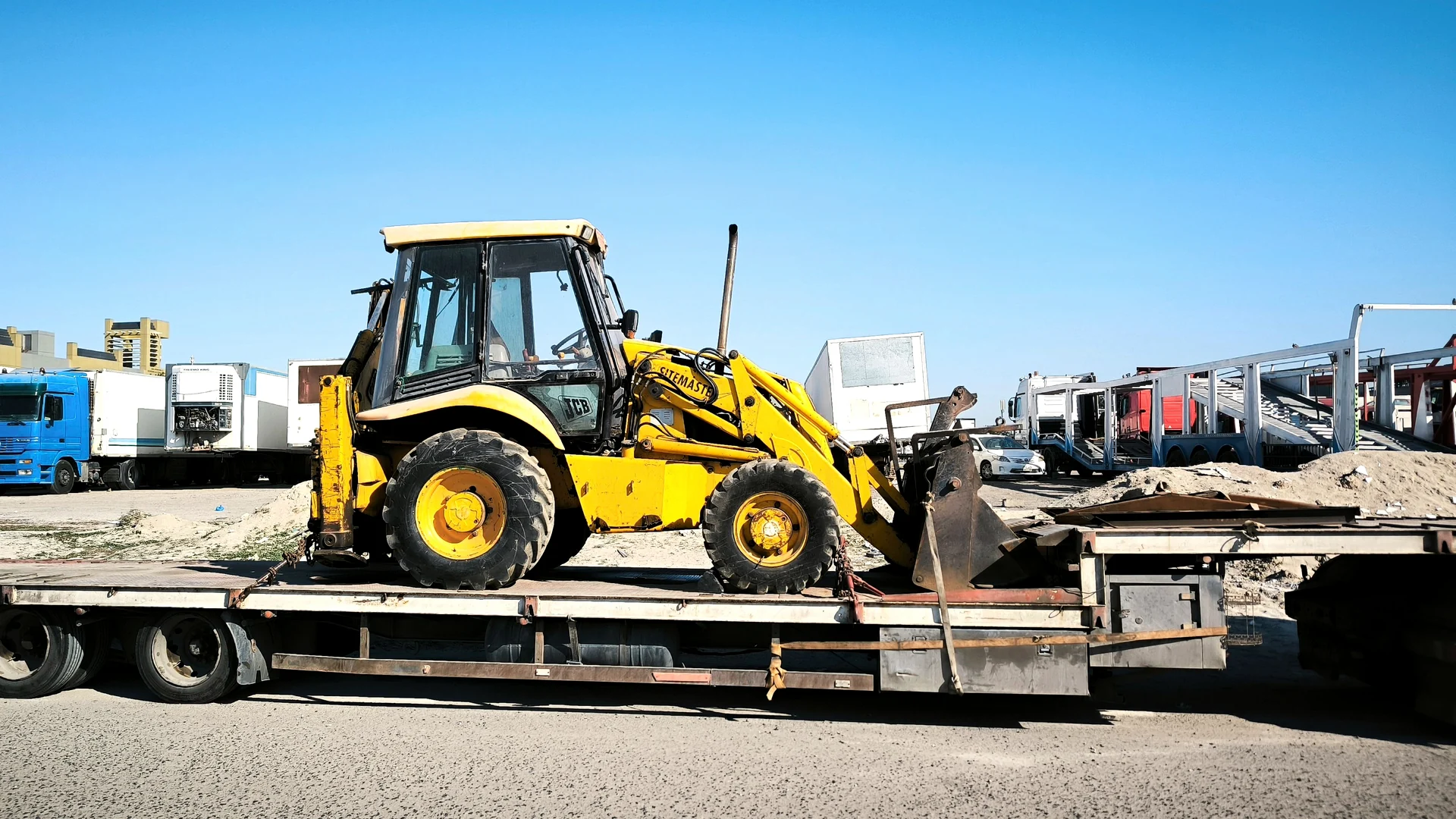
Choice of transport equipment

Which vehicle should be used to transport machinery?

The choice of vehicle for construction machinery, agricultural machinery or public-works equipment transport mainly depends on its weight, dimensions, ground clearance, ability to move under its own power and loading and unloading conditions. A mini excavator, loader, telescopic handler, access platform, agricultural tractor or heavy machine therefore does not always require the same transport equipment.

Machinery carrier

For many wheeled or tracked machines

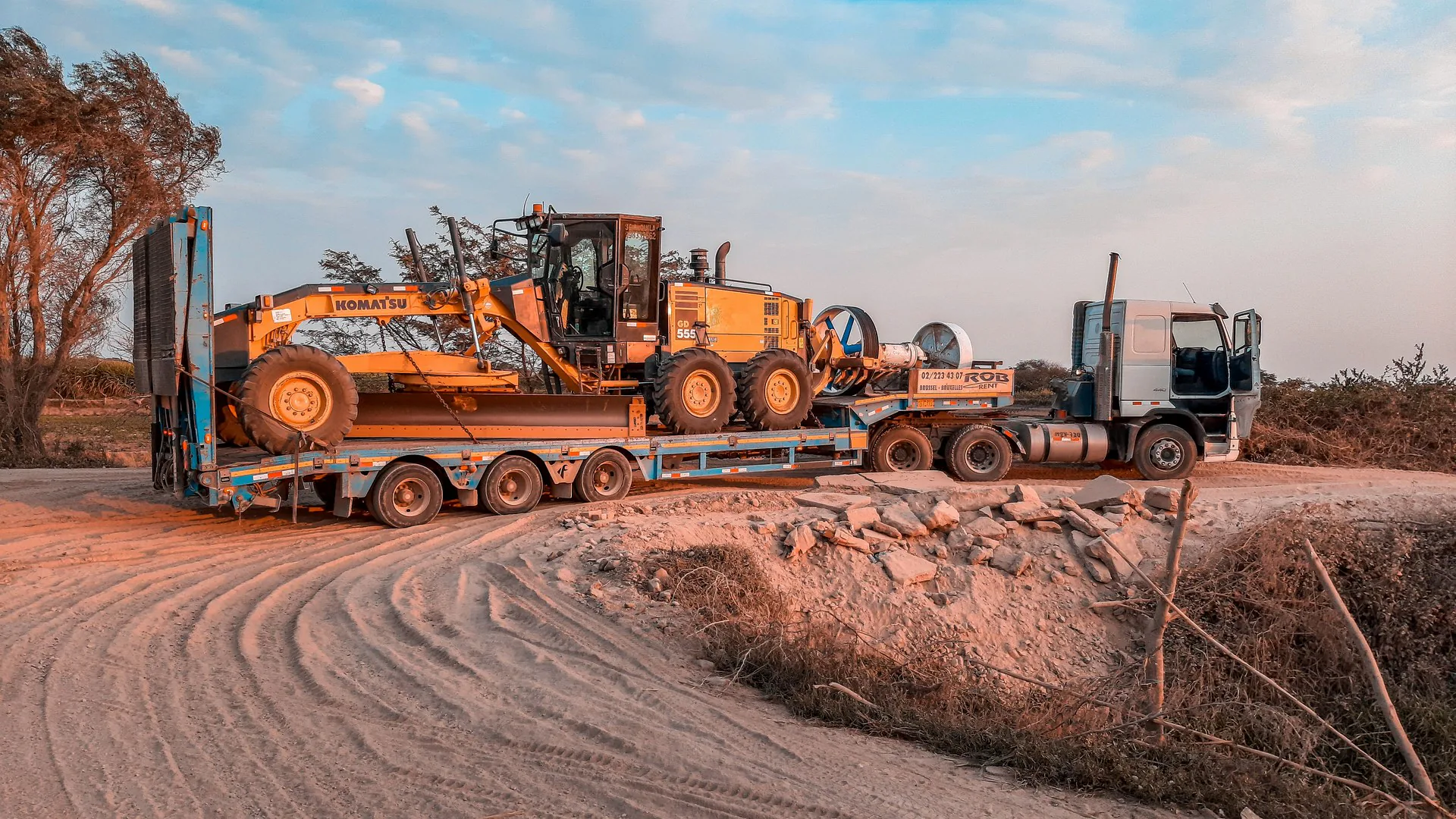
A machinery carrier is specially suited to moving many types of construction or agricultural equipment. Loading can be carried out using ramps compatible with the machine’s width and ground clearance, after which it is immobilised at suitable securing points. This solution is particularly relevant for mini excavators, loaders, access platforms, compactors and certain tractors or other mobile equipment.

Flatbed & trailer

A solution matched to the machine’s dimensions

Depending on the equipment, a flatbed truck, machinery trailer or semi-trailer may be considered. The vehicle is selected using the machine’s actual characteristics: weight, length, width, height, wheelbase, wheel or track type, attachments and the loading equipment available.

Large dimensions

Low-loader and abnormal-load transport where necessary

For a particularly high, heavy or bulky machine, a low-loader configuration can help control the total height of the convoy. When the dimensions or loaded vehicle weight exceed ordinary road limits, the operation may fall under abnormal-load transport and require a route study, permits or suitable escort measures.

Remember: the vehicle must never be selected from the name of the machine alone. Actual dimensions, weight, operating condition, fitted attachments and access conditions at collection and delivery determine the solution that can genuinely be used.

Loading safety

Load securing and safety during transport

The securing of construction or agricultural machinery is an essential stage of its transport. An excavator, loader, tractor, access platform or telescopic handler has considerable mass: during braking, cornering or an emergency manoeuvre, the machine must remain immobilised on the vehicle so that it does not move or compromise the stability of the convoy.

Securing therefore means more than simply ‘tying down’ the machine. Its mass, centre of gravity, the vehicle’s anchor points, the securing points provided on the machine, contact between the machinery and the deck, and the arrangement of the securing devices must all be considered. Chains, straps, tensioners and chocks must be selected consistently with the load to be restrained.

Points to check before departure

  • Immobilise wheels or tracks correctly and use chocks where the configuration requires them.
  • Use vehicle anchor points and machine securing points that are compatible with the forces to be restrained.
  • Use chains, straps or tensioners suited to the machinery’s weight and geometry, without improvising with parts not designed for securing.
  • Place moving equipment in its transport position: boom, bucket, jib, platform and attachments must be lowered, folded or immobilised as appropriate.
  • After loading, check that nothing can move, come loose or project dangerously during the journey.

Even for a short journey, securing must be prepared rigorously. Suitable restraint protects the machinery, the transport vehicle, everyone involved in the operation and other road users.

Drivet Transport International

Frequently asked questions

What types of machinery can be transported?+

Machinery transport can cover mini excavators, excavators, loaders, access platforms, telehandlers, compactors, tractors, agricultural machinery, construction equipment and certain industrial machines. Feasibility mainly depends on the machine’s weight, dimensions, operating condition and the loading and delivery conditions.

Which vehicle is used to transport construction machinery?+

The vehicle is selected according to the machine’s weight, length, width, height, ground clearance and whether it runs on wheels or tracks. Depending on the job, a plant carrier, flatbed truck, suitable trailer or low-loader may be used. Access conditions at collection and delivery also influence the choice.

What information is required for a machinery transport quote?+

Useful information includes the make and model, exact weight and dimensions, photographs, collection and delivery addresses, required dates, whether the machine is running or non-running, any attachments fitted and the access conditions at both sites.

Can a non-running machine be transported?+

Yes, provided an appropriate loading solution is planned. A non-running machine may require a winch, lifting equipment, crane loading or another specific arrangement. This should be stated before transport so that the correct vehicle and equipment can be selected.

Can machinery be delivered directly to a construction site or farm?+

Yes, but access must be reviewed beforehand. Narrow roads, tight turns, gradients, gateways, height or width restrictions, ground conditions, muddy areas and manoeuvring space can all affect the vehicle that can reach the site safely.

When does machinery transport become an abnormal load?+

Machinery transport may fall under abnormal-load rules when the loaded vehicle exceeds the standard regulatory limits for dimensions or weight. A specific review may then be required to determine the transport equipment, route, any required permits and suitable convoy arrangements.

How is machinery secured during transport?+

Securing is planned according to the machine’s mass, centre of gravity, anchorage points, the transport vehicle and the manufacturer’s instructions. Depending on the equipment, chains, suitable straps, tensioners and blocking devices may be used, while booms, buckets, platforms and other moving parts must be placed and secured in a transport-safe position.

Can buckets, forks or other attachments remain fitted?+

It depends on the final dimensions, weight, machine configuration and whether the attachments can be properly secured. Some may remain fitted when compatible with the transport plan, while others are better removed and carried separately to reduce overall dimensions or simplify securing.

Do you arrange transport for tractors and agricultural machinery?+

Yes. Machinery transport can include tractors, agricultural implements, handling equipment and machines destined for farms. As with construction equipment, the vehicle choice depends on dimensions, weight, loading method and the access conditions at the farm or final site.

Can machinery be transported across France and Europe?+

Yes. Drivet Transport International can review machinery movements within France and on European routes. International planning takes account of the machine dimensions, required transport vehicle, access conditions, route constraints and any formalities that may apply.

Transport request

Need a transport quote?

Would you like to organise a machinery transport request? Send us the relevant information so that we can review the solution best suited to your requirements.

Request a transport quote